
STWIN: Advanced, non-destructive technologies to improve friction stir welding of steel through artificial intelligence and smart digital twins
In FSW, a rotating tool is pressed into the gap between two parts. The friction between the tool and the parts produces heat, which leads to plasticising of the materials. The tool is then moved along the joint line. The combination of translation and rotation of the tool transports the material behind the tool, thus creating the joint as shown in the figure.
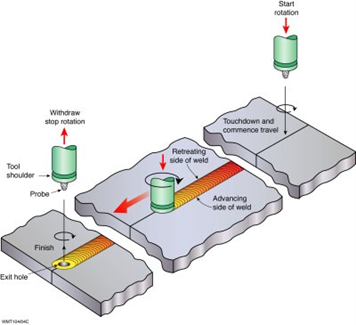
Principle of friction stir welding
But du projet
STWIN pursues to join plain carbon and high strength steels, dissimilar materials and dissimilar thicknesses by friction stir welding. To achieve this aim, the project work will be carried out in the following phases:
- Real time quality monitoring for friction stir welding : Within STWIN, a novel real time monitoring system will be built and demonstrated. The intention is to use the measured process parameters like rotation speed, forces, etc., complemented with other measurements, extracted from a smart combination of sensors.
- Development of Artificial Intelligence models and Digital Twin : The basic of a digital twin is to create a digital counterpart of the reality and linking physical and digital objects in an accurate manner. STWIN will focus on real time monitoring of FSW with the help of a digital twin and AI Machine Learning models.
- Manufacturing processes optimisation : In STWIN, tools will be tested and further improved for welding of steel. Under this context, new tool geometries will be explored in order to optimise the joint properties and tool life.
- Demonstration and validation : In order to validate the developed methods and optimisation strategies at industrial level, STWIN will have a strong demonstration component, comprising the implementation of 3 case-studies. Specifically, the following: joining of high-strength steels for crane applications, welding of complex geometry and mixed materials for automotive sector and joining of aluminium to steel for trailer applications.
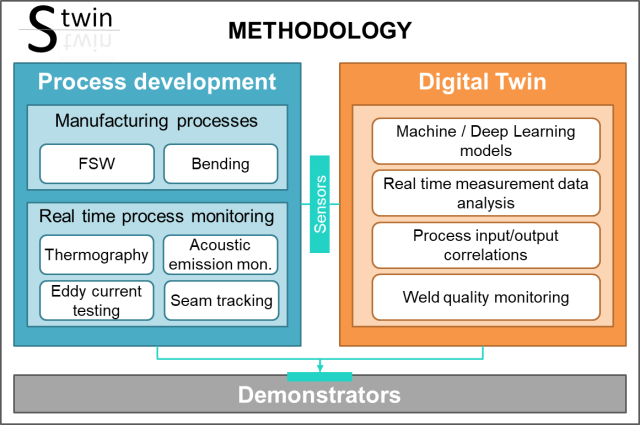
Project objectives
- Optimised process parameters for FSW of 3D joints in high strength steels and for dissimilar joints (steel-aluminium and sheets with dissimilar thicknesses).
- Demonstration of the techno-economic advantages of the new production method using demonstrators.
- Weld quality prediction by AI models, obtained by correlating real-time measurement data during welding with physical weld defects.
- Validation of applicability of real-time quality monitoring in real workshop circumstances, using pilot test-ups of the demonstrators.
Description du projet
Friction stir welding of steel
Besides conventional construction steels, the weldability has been demonstrated for various steels, like low-carbon, dual phase and stainless steels.
In STWIN, tools will be tested and further improved for welding of the steels in the focus of the project. Friction stir welding of high strength steels will be investigated. New tool geometries will be investigated in order to optimise the joint properties and tool life.
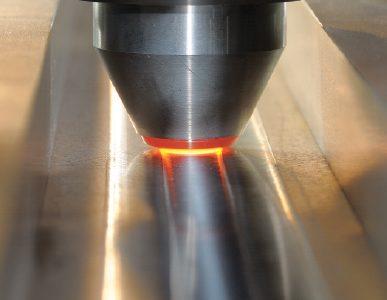
Video : FSW of steel :  weld_112_2024-10-15_14.mp4
Friction stir welding of steel-aluminium dissimilar joints
FSW is a solid-state welding process where no melting is involved, making it suitable for dissimilar joints. In STWIN, several techniques will be addressed in order to overcome the challenges of dissimilar material welding. Further research will be conducted to achieve higher and optimised joint strengths for FSW of aluminium to steel.
Real time quality monitoring
Only little research has been done for real time quality monitoring of FSW. There is consequently a growing need for cost-effective quality monitoring for this process. In STWIN, a novel real time monitoring system will be built and demonstrated. The intention is to use the measured process parameters like rotation speed, forces, complemented with the measurements by a smart combination of sensors.
STWIN will use a well-considered combination of sensors, each with its detection capabilities and limitations, more specific acoustic emission monitoring, thermography and eddy current monitoring. By this strategy, the detection capabilities of the monitoring system will be increased.
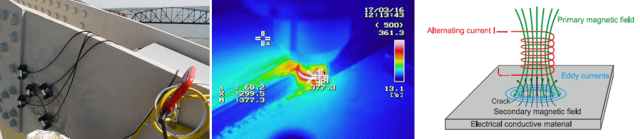
Left: AEM of structural parts of steel bridges
Middle: Thermography applied to FSW of aluminium
Right: Principle of eddy current testing
Digital twin
The basic idea of a digital twin is to create a digital counterpart of the reality and linking physical and digital objects in an accurate and real-time manner.
STWIN will focus on real time monitoring of FSW using multiple sensors, whose measurements will be analysed by AI Machine Learning models.
The signals will be analysed and processed in real time through various signal processing and machine learning techniques. The model will provide feedback regarding the joint quality.
Demonstration and validation
In order validate the developed methods and design strategies at industrial level, STWIN will have a strong demonstration component, comprising the implementation of 3 case-studies, more specific joining of high-strength steels for crane applications, welding of complex geometry and mixed materials for automotive sector and joining of aluminium to steel for trailer applications.
Project partners

CIDAUT (Valladolid, Spain - www.CIDAUT.es)
CIDAUT has extensive experience in project management at regional, national and European level and will coordinate the project. CIDAUT applies concurrent engineering techniques, including industrial processes, and can arrive at the full industrialisation of the solutions. CIDAUT evaluates the solutions by simulations and technological test beds, including process sensoring (instrumentation and mechatronics), condition-based maintenance, and data analytics.
Belgian Welding Institute (Zwijnaarde, Belgium - www.BIL-IBS.be)
BWI is an independent non-profit organisation, providing welding research and development, education, training and transferring knowledge and all service-relevant information to the industry. BWI has a team of 25 experienced researchers with backgrounds in welding, metallurgy, mechanical and civil engineering. BWI has more than 50 years of experience in research for welding and related technologies, weldability of various materials and the behaviour of welded components and structures in service.
BWI has more than 25 years of experience with solid-state welding processes, in particular with friction-based processes.

ISEND (Valladolid, Spain - www.isend.es)
ISEND is a company specialised in the development of technological solutions for the detection of surface defects in steel and other metals. It is a high-tech company, focused on the design, manufacture and development of non-destructive testing solutions based mainly by Eddy current techniques, but also on digital imaging for online and offline metal products producers.
STIRWELD (Bruz, France - https://stirweld.com)
STIRWELD is a French start-up specialising in producing low cost FSW (Friction Stir Welding) solutions, founded in 2017. Its mission is to guide companies in the discovery and implementation of the FSW technology. STIRWELD will use its expertise for the investigation of FSW of aluminium to steel, using a FSW head mounted on a CNC machine.

SSAB (Borlänge, Sweden - www.ssab.com)
SSAB is a highly-specialized global steel company who develops high-strength steels and provides services for better performance and sustainability. The company is a leading producer on the global market for Advanced High-Strength Steels (AHSS) and Quenched & Tempered Steels, strip, plate and tubular products, as well as construction solutions. SSAB’s steels and services help to make end products lighter and increase their strength and lifespan.

Element6 (Shannon, Ireland - www.e6.com)
Element Six is a global leader in the design, development and production of synthetic diamond and tungsten carbide supermaterials. Element6’s focus has been on developing the diamond synthesis process to enable innovative synthetic diamond and tungsten carbide solutions. As well as being the planet’s hardest material, diamond’s extreme and diverse properties give it high tensile strength, chemical inertness, broad optical transmission and very high thermal conductivity. One of the activities is the design and development of tools for friction stir welding.

GRANALU (Segovia, Spain - www.granalu.com)
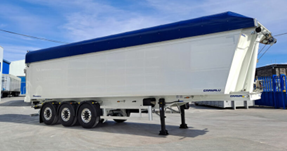
GRANALU is a leading company in the construction of aluminium tipping semi-trailers and movable floors. GRANALU is a young company with a highly qualified staff in the handling different machining and welding processes. Aluminium is used as the base material for the construction of GRANALU tipping semi-trailers and moving floors. FSW will replace bolted connections of aluminium and steel plate constructions.

HIAB (Hudiksvall, Zweden – www.HIAB.com)
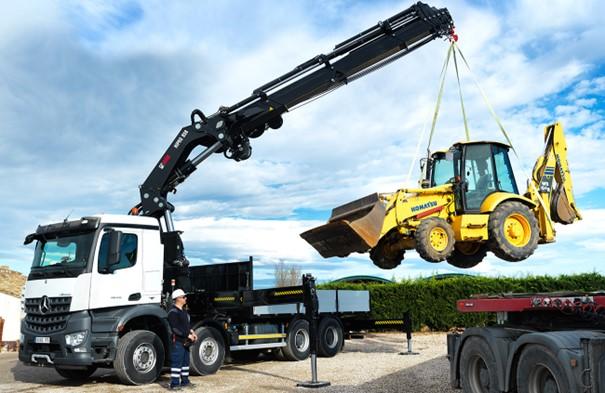
Hydrauliska Industri AB (HIAB) is a Swedish manufacturer of loader cranes, demountable container handlers, forestry cranes, truck-mounted forklifts and tail lifts. Its customers range from single truck owners to international fleet operators across a wide variety of industries. As the industry pioneer and with a proud 75 year history, Hiab is committed to inspire and shape the future of intelligent load handling.
HIAB will investigate FSW for welding of high strength steels for loader crane applications.
Résultats
To be updated soon.